"I had my car treated with the ceramic coating and paint protection film from TIMO Detailing Services, and I couldn't be happier. The team was professional, efficient, and took the time to explain the process. My car looks amazing, and I no longer worry about minor scratches or bird droppings damaging my paint. Highly recommend!"
John D.
"I’m beyond impressed with the mobile detailing service I received from TIMO Detailing. They came to my home and worked on my SUV while I was at work. When I came back, it looked brand new inside and out. They really pay attention to the details and it’s clear they use high-quality products."
Sarah M.
"I’ve had my car detailed multiple times, but nothing compares to the quality of service provided by TIMO Detailing Services. Their paint protection film is top-notch and really helps protect my vehicle from the harsh elements. The team was courteous and thorough, and my car has never looked better."
Michael P.
"TIMO Detailing Services did a phenomenal job on my boat! The team applied a protective coating that made a huge difference, keeping the surfaces clean and easy to maintain. Plus, the shine is incredible. They’re definitely the go-to for all your detailing needs!"
Rachel F.
"I just had my RV detailed by TIMO Detailing Services, and the results exceeded my expectations. They treated both the interior and exterior, and everything looks fantastic. It’s like having a brand new RV again. I appreciate the attention to detail, especially when it comes to hard-to-reach areas."
James L.
"TIMO Detailing Services is the best in the business! I had their mobile detailing team come to my workplace and clean my car while I was in meetings. The entire experience was so easy and the results were amazing. My car hasn’t looked this good in years. I’ll definitely be a repeat customer."
Sophia G.
"I’ve tried a lot of different detailing services over the years, but TIMO Detailing Services stands out. Their customer service was top-notch, and the team went above and beyond to ensure my car was spotless. I opted for their ceramic coating service, and it made the paint on my car look like glass!"
David H.
"I cannot say enough good things about TIMO Detailing Services. They applied paint protection film to my luxury car, and the results are amazing. The film is invisible, and it has kept my vehicle’s paint free from chips and scratches. It’s a game-changer for maintaining my car’s value."
Olivia W.
"What an incredible experience! I had TIMO Detailing Services apply ceramic coating to my truck, and I’m so impressed. The process was quick, the team was professional, and the finish is just stunning. The hydrophobic properties make washing so much easier, and the car stays clean much longer."
Lucas B.
"TIMO Detailing Services did a fantastic job detailing the interior of my car. The team was thorough, cleaning every corner, vacuuming every surface, and conditioning the leather seats. I can’t believe how refreshed my car looks and smells! I will definitely be using them for regular maintenance."
Ella S.
"I had my motorcycle detailed by the team at TIMO Detailing Services, and I’m so happy with the results. They applied paint protection film and gave the bike a full exterior clean. The shine is amazing, and I don’t have to worry about scratches or chips anymore. Highly recommend them for any vehicle!"
George T.
"TIMO Detailing Services exceeded all my expectations. The mobile detailing team arrived on time, was incredibly professional, and did an amazing job. My car looks brand new again, both inside and out. They really take pride in their work, and it shows. I will be recommending them to all my friends and family."
Charlotte R.
Professional Ceramic Coating in Westchase
Less Washing, Stronger Protection, Easier Maintenance
Your car stays cleaner longer. Water beads off like it’s been waxed every week, except you’re not waxing it every few months anymore.
That’s what nano ceramic coating does. It bonds to your clear coat at a molecular level, creating a hydrophobic barrier that repels water, resists chemicals, and makes washing take half the time. Bird droppings wipe off before they etch. Bug splatter rinses away instead of baking into the paint.
In Westchase, where afternoon storms leave hard water spots and the sun beats down year-round, a quality 9H ceramic coating is the difference between paint that fades in three years and paint that still looks sharp in five. You’re not just protecting the finish. You’re protecting what you paid for the vehicle and what you’ll get back when you sell it.
Westchase Mobile Ceramic Coating Experts
We Started During COVID, Built on Referrals
We launched Timo Detailing Services in 2020 when most businesses were shutting down. We grew because we showed up on time, did the work right, and didn’t cut corners to save twenty minutes.
We’re fully insured. We use professional-grade products. And we come to your home or office in Westchase so you’re not driving across Tampa to drop off your car for three days.
Most of our clients find us through someone who already used us. That happens when you take the extra time to prep the paint correctly and apply ceramic coating the way it’s supposed to be applied—not rushed, not shortcuts.
How Ceramic Coating Application Works
What Happens When We Coat Your Vehicle
First, we wash and decontaminate the entire surface. That means removing embedded brake dust, tar, tree sap, and anything else stuck in the paint. If it’s not clean at a microscopic level, the coating won’t bond properly.
Next, we correct the paint. Light scratches, swirl marks, oxidation—we polish those out so the coating goes on a smooth, clean surface. This step matters more than most people realize. Coating over scratches just locks them in.
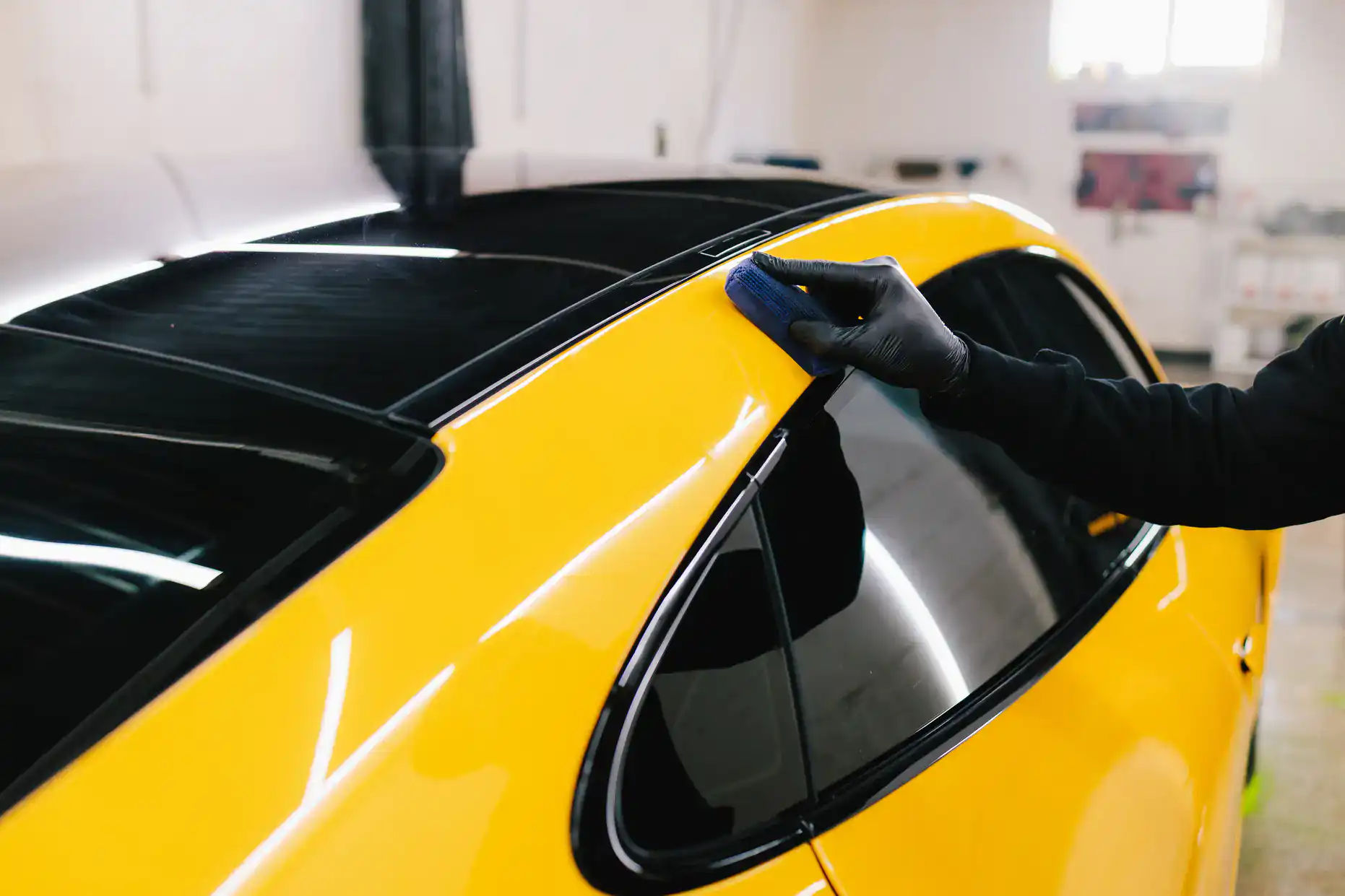
Then we apply the ceramic coating panel by panel. It cures as it sits, forming a hard, glass-like layer over your clear coat. Depending on the package, this takes several hours. We don’t rush it.
After application, the coating needs 24 to 48 hours to fully cure. During that time, keep the vehicle dry and out of direct sun if possible. Once cured, you’ve got a layer of protection that’ll last years, not months.
You’re getting a coating that lasts up to five years depending on how you maintain it. That’s not marketing talk—that’s the actual durability of a properly applied nano ceramic coating compared to traditional wax or paint sealant alternatives that break down in a few months.
The coating is hydrophobic, meaning water rolls off in beads instead of sitting on the surface. It’s chemically resistant, so acidic contaminants like bird droppings or bug guts don’t bond to the paint. And it provides serious UV protection, which matters in Florida where the sun destroys clear coat faster than almost anywhere else in the country.
In Westchase, you’re dealing with hard water from sprinklers, pollen that sticks to everything, and love bugs twice a year. A ceramic-coated vehicle handles all of that better. You’ll wash it less. It’ll stay glossy longer. And when you do wash it, the dirt comes off easier because nothing’s sticking to the coating.
This also gets recorded on your CARFAX report if you want it documented. That’s verified proof the paint was professionally protected, which helps resale value when you’re ready to sell or trade.
How long does ceramic coating actually last in Florida?
A professionally applied ceramic coating lasts between three and five years in Florida, depending on how you maintain it and how much sun exposure the vehicle gets. If it’s garaged and hand-washed regularly, you’ll get closer to five years. If it sits outside in a Westchase driveway under full sun and goes through automatic car washes every week, expect three to four years before the hydrophobic properties start to fade.
The coating doesn’t just disappear one day. It gradually loses its water-beading effect and chemical resistance over time. But even at the end of its life, your paint is still in better shape than it would’ve been without it.
Traditional wax lasts two to three months in Florida heat. Synthetic sealants might give you six months. Ceramic coating gives you years. That’s the difference you’re paying for.
Does ceramic coating prevent scratches and swirl marks?
No, ceramic coating doesn’t prevent scratches. It’s not a clear bra or paint protection film. It’s a hard layer over your clear coat, but it’s measured in microns—it’s thin.
What it does is make your paint more resistant to light marring and swirl marks from washing. If you drag a dirty sponge across a non-coated car, you’re grinding dirt into the clear coat and creating scratches. On a ceramic-coated surface, contaminants don’t bond as tightly, so there’s less friction and less damage during washing.
You can still scratch a coated car if you hit it with something or scrub it with a dirty towel. The coating just makes normal wear and tear less visible over time. It also makes it harder for things like tree sap or bird droppings to etch into the paint, which is a big deal in Florida where both of those are constant problems.
Can I wash my car normally after ceramic coating?
Yes, but you’ll want to avoid automatic car washes with harsh brushes. Those can degrade the coating faster and introduce scratches. Hand washing or touchless washes are better.
The good news is washing gets way easier. You don’t need to scrub as hard because dirt doesn’t stick the same way. A basic pH-neutral soap and a microfiber mitt are all you need. Rinse, wash, rinse again—done.
You also don’t need to wax it. The coating is doing what wax used to do, except it’s doing it better and lasting longer. Some people apply a ceramic spray booster every few months to keep the water beading strong, but that’s optional. The coating itself doesn’t need constant maintenance. Just keep it clean and it’ll keep performing.
How much does ceramic coating cost in Westchase?
Professional ceramic coating typically starts around $800 and can go over $1,500 depending on the size of the vehicle, the condition of the paint, and the level of prep work required. If your paint has heavy swirl marks, oxidation, or scratches, more paint correction is needed before the coating goes on, which adds time and cost.
That sounds like a lot compared to a $30 wax job. But wax lasts a few months. Ceramic coating lasts years. If you’re waxing your car four times a year, you’re spending $120 annually. Over five years, that’s $600—and your paint still isn’t protected the way it would be with a real coating.
You’re also paying for mobile service. We come to your house or office in Westchase, do the work on-site, and you don’t lose a day dropping off and picking up your car. That convenience is built into the price.
Is ceramic coating worth it for a daily driver?
Yes, especially in Florida. Daily drivers take the most abuse—parking lot dings, road grime, constant sun exposure, rain, pollen, bugs. If you’re keeping the car for more than a few years, ceramic coating makes sense.
Your paint stays cleaner between washes. You spend less time scrubbing bug guts off the front bumper. Water spots from hard water don’t etch into the clear coat as easily. And when you go to sell or trade the vehicle, the exterior is in noticeably better condition than a comparable car that wasn’t coated.
It’s not just for luxury cars or show cars. Teslas, trucks, SUVs—anything you’re driving regularly in Westchase benefits from long-term paint protection. You’re making an investment in keeping the vehicle looking newer for longer, which protects its resale value and saves you maintenance headaches.
What's the difference between ceramic coating and paint protection film?
Paint protection film (PPF) is a thick, clear urethane layer that physically absorbs impact. It prevents rock chips, scratches, and deeper damage. It’s usually applied to high-impact areas like the front bumper, hood, mirrors, and door edges. PPF costs more—often $1,500 to $3,000+ depending on coverage.
Ceramic coating is a liquid polymer that bonds to your clear coat and hardens into a thin protective layer. It doesn’t stop rock chips, but it does resist UV damage, chemical etching, and water spotting. It also makes the paint easier to clean and keeps it glossy longer.
Some people do both—PPF on the front end for physical protection, ceramic coating over the rest of the car for chemical and UV resistance. That’s the ultimate setup, but it’s not necessary for most drivers. If you’re mainly worried about sun damage, bird droppings, and keeping your car cleaner in Westchase, ceramic coating handles that. If you’re worried about rock chips on the highway, PPF is the better option.